Friday, January 25, 2013

Columbia River: Following Lewis and Clark:

"... we arrived at the great Columbia River, which comes in from the northwest. We found here a number of natives, of whose nations we have not yet found out the names. The country all round is level, rich and beautiful, but without timber ..." Lewis and Clark's Corps of Discovery, October 1805.
Heading west along the Columbia River
No services for 80 miles
Vineyards and Stone Hedge
Morning fog on the river
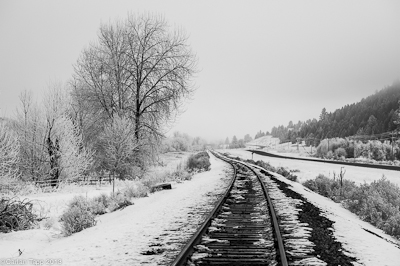
The rail route snakes along the great river
Looking south across the river into Oregon
Lewis and Clark began their journey along the Columbia River in October and reached the Pacific Ocean in November. I wonder if they could ever imagined the proposal of transporting coal half way around the world today in the same amount of time?

"Every action should be taken with thoughts of its effects on children seven generations from now."  Cherokee

be strong, be safe, Carlan

Thursday, January 24, 2013

Eastern Washington: Places Lesser Known:

Today snow, ice rain and the open plains of Eastern Washington. I am driving through Fishtrap, Sprague, Ritzville, Lind, Cunningham, and Hatton along the China Express.
Near Fishtrap, WA.
Sprague, WA.
Grain elevators dot the landscape.
Lind: Home of the Combine Demolition Derby.
Lunch at Jakes Homecooking Cafe. Famous for homemade donuts. Never saw any donuts here.
Coal train outside of Hatton, WA.
The Washington wheat plains stretch to the horizon.
This section of the rail route seems to speak of "harvest and stewardship".  The importance of community and how we will define it for future generations.

“The earth will not continue to offer its harvest, except with faithful stewardship. We cannot say we love the land and then take steps to destroy it for use by future generations.”  Pope John Paul II

be strong, be safe, Carlan


Wednesday, January 23, 2013

Missoula to Spokane: Flathead River Country

The Flathead Indian Reservation, located along the rail route on the Flathead River, is home to the Bitterroot Salish, Kootenai, and Pend d'Oreilles Tribes.
Native Americans have lived in Montana for more than 14,000 years, based on archaeological findings. The Bitteroot Salish came from the West Coast, whereas the Kootenai lived mostly in the interior of present-day Idaho, Montana, and Canada. The Kootenai left artifacts in prehistoric time.
An ice fog covers the trees and landscape along HWY 200.
The rail route twists and curves along the Flathead River.
The Flathead River joins the Clark Fork River.
Fences built to block long horn sheep crossing to the river for water.
The beauty of the day and the landscape brought a peace to my mind.  I could not help but think of the words of Chief Seattle: “We do not inherit the earth from our ancestors; we borrow it from our
children”.


be strong, be safe, Carlan

Monday, January 21, 2013

Billings to Missoula MT:

Outside of Billings this morning the refineries were filling the skies for miles.
The plan today was to follow the proposed rail route from Billings into Missoula.  Thought I would share some of the landscape I traveled through today following the route.
Small rail crossings dot the landscape with gravel roads leading to ranches.
The rail leaves I90 and travels along small country roads, through towns long since deserted.
 
The landscape is spectacular.  Mountain ranges rise in every direction.
Near the headwaters of the Missouri River the rail crosses a frozen section of the river.
Outside of Helena along Highway 12 empty coal cars head east toward the Powder River Basin to be reloaded.
This is cattle country.  Grazing cattle along the rail were a common sight today. 
The route rejoins I90 at Garrison and heads into Missoula.  It was a beautiful day today.  Traveling through the mountain ranches, into and out of small quiet towns, counting grazing cattle by the hundreds, sun sparkling on frozen rivers and streams, and watching clouds form and float across the blue skies.  Hard to imagine how this may change.

be strong, be safe, Carlan
 

Sunday, January 20, 2013

Defending a Way of Life:

Leaving Gillette, WY yesterday the rail west heads across open country towards Billings, MT.  A quiet open road. LJ Turner's stories from yesterday ringing in my head and heart.  On any day there can be 40-50 trucks carrying unknown individuals driving across his ranch land.  White trucks with orange flags.  Checking methane wells, monitoring gas pipe lines, surveying mineral resources, building new access roads.  LJ has written letters, asked questions, searched for answers.  In most cases there has been no response, no answers to "why".  He shared his stories with me for over 8 hours without stopping.  In the moments of silence between us I felt the deepening sense of loss.  Loss of a way of life.
I followed the rail line along country roads dotted with gas and oil wells until I met I90 west. Joining the interstate I realized where I was. The Little Big Horn Battle Field.
Recently new markers have been placed in the battle field.  Markers 135 years later speaking of "defending a way of life".  As I walked across the battle field my heart was full, full with the magnitude of what I had seen, stories heard, losses shared. I thought of the stories LJ shared with me.  Stories about "defending a way of life".  What has changed?  Do we simply repeat history?  Will there be a marker one day on a WY ranch with "defending a way of life" carved into the stone?

be strong, be safe, Carlan

Saturday, January 19, 2013

Wright WY it all starts here:

Spent the day with a Wyoming rancher.  His family homesteaded the ranch in 1918.  The Turnercrest Ranch is in the center of the Powder River Basin coal strip mines.
They have lost over 6,000 acres to the strip mines.  Cattle herds once numbering over 450 head have been reduced to less than 200.
Water drawn off by the mining has caused wells in the area to drop an average 600 feet.  Local streams and waterways have run dry.
The largest open pit coal mines in the world are here.  The mines cover an area 60 miles long by 10 miles wide.
Mined coal is transported via conveyor systems to silos for loading into rail cars.
Empty rail cars move through the silos at 5 miles per hour and are filled for transport.  135 trains with an average of 150 cars each leave the Powder River Basin daily carrying coal across the United States.

I'm heading west following the route to the Pacific Northwest.

be strong, be safe, Carlan


Thursday, January 17, 2013

China Express:

I'm on the road in Wyoming tonight to begin a project we're calling "The China Express."
Rail lines for coal trains leaving the Powder River Basin in WY
As the United States continues to lower its dependency on coal, coal companies have turned to China. Currently, there are 4 daily trains each with over 100 cars of coal being railed from Wyoming to British Columbia where it's shipped to China. For every 500 miles a train travels it loses up to 0.6 tons of coal dust per car polluting communities, ranches and agriculture. Coal cars can't be covered because of spontaneous combustion. A proposed expansion (permits are pending) will increase the number of trains per day to 18. This expansion will also create a new mega mine in Montana and new shipping terminals in WA, OR and CA.

My plan is to follow the entire train route from here in WY to the Pacific Northwest proposed port in Bellingham, WA. I'll document the people and places along the way. I expect to be on the road for 3 weeks.
Platte River, WY
Had a beautiful drive into WY today.  Clear skies and mild temperatures.  This is an incredible part of our country.  It is also known as the "Energy Center" for the United States.
Buffalo graze near gas and oil development
Open plains where buffalo once freely roamed are now major producers of gas, oil, and coal.  Seeing this for the first time today it was difficult to photograph, much less take in, the magnitude of change occurring.

Still sorting it out tonight as I begin to spend the next several weeks documenting the current and proposed export route of our natural resources to China.

be strong, be safe, Carlan